Beacon — 12th Edition · IUT Computer Society
From Prompting to AI Engineering
July 2026
A dive into how the discipline evolved from 2022 to 2026
A few years ago, building with large language models seemed deceptively simple: write a clever prompt, press Enter, and watch the model respond. That era is over. As LLMs evolved from conversational tools into the engines powering modern software, the real engineering challenge shifted away from crafting perfect prompts and toward designing the systems that surround them. Today’s AI applications depend on carefully orchestrated data pipelines, retrieval mechanisms, execution loops, memory, tool integration, and robust guardrails that determine what the model sees, what it can do, and how it behaves. Prompting still matters, but it is no longer the centerpiece. It has become just one component in a far richer software architecture, where success is defined not by a single sentence, but by the intelligence of the entire system.
The Evolution of Prompting
When generative models launched in late 2022, the chat window was the primary interface. Developers used role assignments, step-by-step instructions, and few-shot examples to alter behavior without retraining. Tools like LangChain and LlamaIndex emerged to template these inputs programmatically. This approach allowed domain experts to customize models without the heavy compute budgets required for fine-tuning.
By 2026, context windows expanded to hundreds of thousands or millions of tokens, altering this dynamic. Multi-turn agents began executing dozens of tool calls and processing large volumes of intermediate data. Consequently, the initial user prompt became a minor fraction of the total information entering the model.
What Is Prompt Engineering?
Prompt engineering is the optimization of input text to steer model output without modifying underlying weights, relying on in-context learning within active memory. By 2026, the discipline
shifted from writing long prose to drafting precise specifications covering success criteria, output formats, constraints, inputs, examples, verification rubrics, and clarification routines.
Empirical testing validates several techniques. Chain-of-thought prompting increases accuracy by 15 to 40 percent on multi-step reasoning, though it offers little benefit to reasoning-native models. Self-consistency and Tree of Thoughts improve benchmark performance but increase token costs five to fifty times. Prompting has clear limitations. Because models operate on probability distributions rather than deterministic logic, minor text changes cause unpredictable outputs. Long contexts often trigger attention degradation where information in the center is ignored, a phenomenon known as being lost in the middle. Finally, mixing user data and system instructions in a single stream leaves applications vulnerable to prompt injection attacks.
Why Prompt Engineering Is No Longer Enough
Prompt engineering addresses a single question: what do we say to the model? While sufficient for single-turn interactions, this framing fails when an autonomous agent runs for dozens of iterations, queries tools, and generates complex intermediate logs. The core challenge has shifted from formatting the initial instruction to managing what the model sees throughout execution and designing the deterministic systems that constrain it.
The Rise of AI Engineering
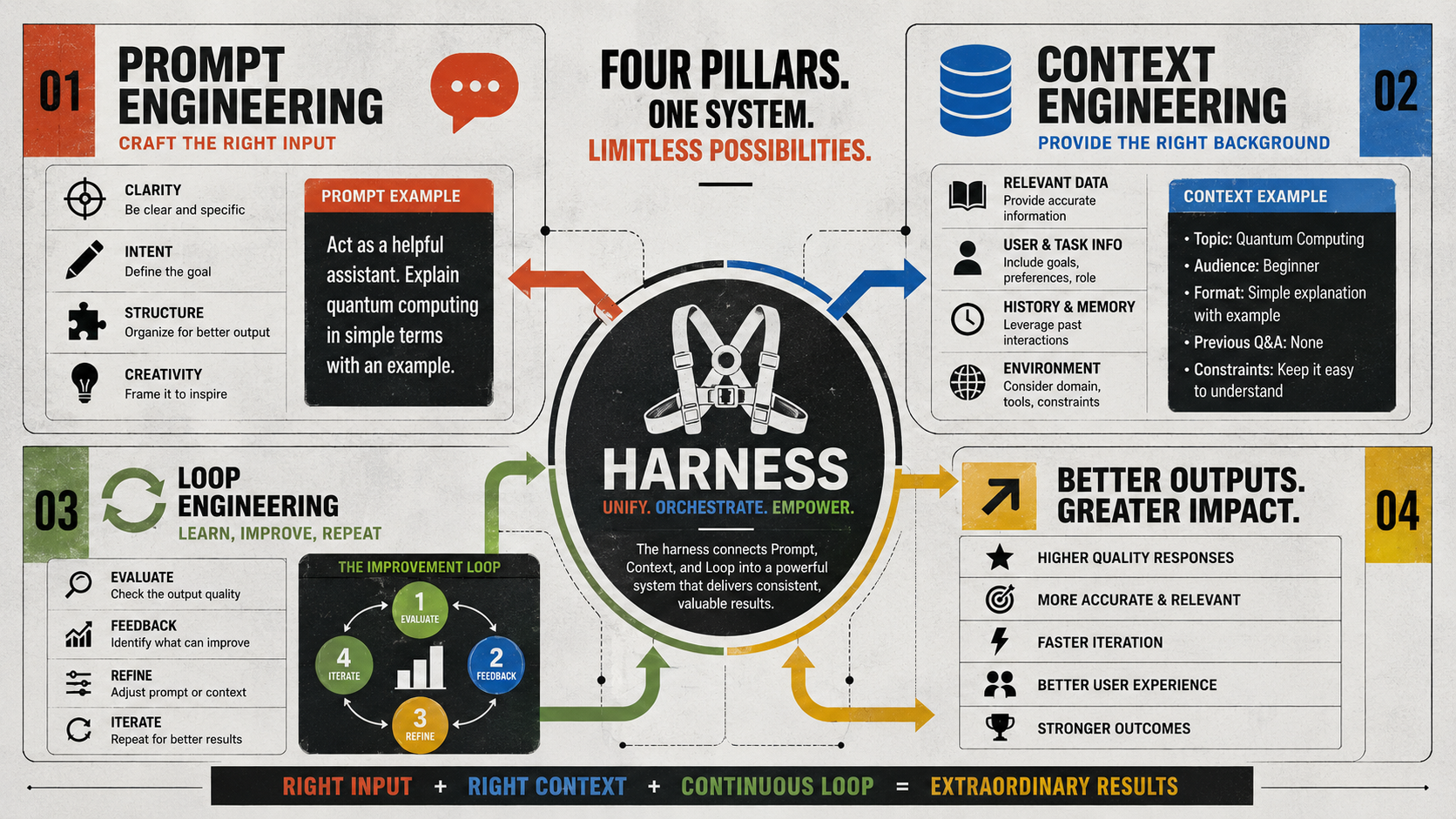
In 2025, development transitioned from prompt engineering to broader architectural practices. This introduced a hierarchy of specialized disciplines: context engineering for data curation, loop engineering for execution flow, and harness engineering for production systems. These layers function together. Prompt design is contained within context engineering, which operates inside an execution loop, all enclosed by the system harness. Teams scale through these layers as application complexity grows.
Context Engineering
Context engineering manages what data a model sees at inference time. Popularized by practitioners like Andrej Karpathy and Joshua Noble, the field treats the context window as a space
requiring strict curation. Expanded context windows led developers to dump entire codebases or databases into models, which degrades attention, raises hallucination rates, and inflates costs.
Teams manage these issues using four strategies:
| Strategy | What it does | When you’d use it |
|---|---|---|
| Write | Craft system prompts with precise instructions and output specs |
Short, single-turn tasks |
| Select | Pull in relevant information dynamically: search, retrieval, tool calls |
Knowledge-heavy tasks |
| Compress | Summarize or prune context to fit available space |
Long-running agents, large documents |
| Isolate | Split concerns into separate context windows (sub-agents, namespaces) |
Multi-agent or complex workflows |
Anthropic engineers note that optimizing the tokens a model samples from directly impacts performance. Proper context management allows smaller, cost-effective models to outperform frontier setups processing unorganized data.
Loop Engineering
Loop engineering designs the triggers, stopping conditions, and feedback systems that enable agents to execute multi-step operations without human intervention. This automation transforms models from static question-answering tools into systems capable of independent iterative tasks.
Modern architectures build on the traditional ReAct (Reason and Act) framework. For example, the Reflexion framework splits execution among three roles: an Actor that takes action, an Evaluator that scores results, and a Self-Reflection step that records failures in episodic memory
to guide the next attempt. Without strict bounds, loops risk entering infinite reflection cycles or exhausting token budgets. Resolving these behaviors requires refining the operational loop rather than upgrading the underlying model.
AI Harnesses and Orchestration
Harness engineering encompasses the infrastructure, guardrails, memory, and verifications wrapped around a model to ensure production reliability. In 2026, OpenAI demonstrated this by deploying over a million lines of production code generated by agents operating within strict structural constraints.
Data highlights the impact of system design over text optimization. Harness optimization improved agent solve rates by 64 percent, lifting a coding benchmark score from 52.8 to 66.5 percent. An MIT study attributed 95 percent of failed enterprise AI pilots to inadequate system architecture rather than flawed prompts.
Birgitta Bockeler of ThoughtWorks structures the harness around three pillars: continuous context enrichment, enforcing boundaries via deterministic linters or continuous integration gates, and running automated agents to manage documentation drift. Enterprise implementations show clear results. Microsoft’s Azure SRE teams use structured harnesses to manage incidents, reducing mean time to mitigation from forty hours to three minutes. Similarly, Spotify’s internal tools have merged over 1,500 automated pull requests. When errors occur, engineers introduce permanent system constraints rather than tweaking individual prompts.
Recent Industry Trends
Production environments increasingly route queries across multiple models to balance cost and performance. Beyond technical mechanics, automated development introduces organizational challenges. Margaret-Anne Storey frames these risks through a triple debt framework: cognitive debt, where teams lose their shared understanding of a codebase, and intent debt, which occurs when a lack of documented human reasoning causes agents to make faulty assumptions.
To mitigate this, Mitchell Hashimoto recommends manually replicating agent workflows to map blind spots and turn errors into structural fixes. While terms like context or harness engineering
lack deep academic literature compared to traditional reinforcement learning, these practices define current enterprise deployment.
Challenges and Future Directions
Operational constraints remain a major hurdle. Moving from single-pass inference to multi-step search frameworks like Language Agent Tree Search multiplies token consumption and energy footprints. Long-horizon autonomy, where systems execute multi-day tasks independently, remains limited by tool error cascades and planning drift. Security presents another challenge. Granting agents system execution privileges, such as running terminal commands or modifying database schemas, requires balancing safety boundaries with operational utility, a balance current frameworks have not resolved.
Conclusion
The era when AI engineering revolved around crafting the perfect prompt is coming to a close. Today’s most capable systems succeed not because of a single, well-written instruction, but because of the sophisticated architecture that surrounds the model—integrating data, memory, tools, execution logic, and safety into a coherent whole. Prompt design remains an indispensable discipline, shaping how models reason and respond, yet it is now only one piece of a much larger engineering puzzle. As large language models continue to advance, the defining challenge will no longer be writing better prompts, but building better systems. In the next chapter of AI, the true measure of innovation lies not in what we ask the model, but in how intelligently we orchestrate everything around it.
References
-
Agent Shortlist. (n.d.). Loop engineering: Self-prompting patterns.
-
Anthropic. (n.d.). Effective context engineering for AI agents.
-
Data Science Dojo. (n.d.). 10 loop engineering design patterns.
-
deepset. (n.d.). Harness engineering for reliable AI agents.
-
Fowler, M. (n.d.). Harness engineering. ThoughtWorks.
-
Gartner. (2025). Context engineering is in, and prompt engineering is out.
-
Lakera. (n.d.). The ultimate guide to prompt engineering 2026.
-
Lushbinary. (n.d.). Advanced prompt engineering techniques: A developer’s guide.
-
Lushbinary. (n.d.). Context engineering for AI agents: A production guide.
-
n1n.ai. (n.d.). The billion-dollar while loop: Emergent architecture in AI agents.
-
OpenAI. (2026, February). Harness engineering.
-
Prompt Builder. (n.d.). Prompt engineering best practices 2026.
-
Shinn, N., Cassano, F., Berman, E., Gopinath, A., Narasimhan, K., & Yao, S. (2023). Reflexion: Language agents with verbal reinforcement learning. Advances in Neural Information Processing Systems, 36.
-
Wharton Prompting Science Report. (2025). Every prompt engineering technique explained. SurePrompts.
-
Yao, S., Zhao, J., Yu, D., Du, N., Shafran, I., Narasimhan, K., & Cao, Y. (2023). ReAct: Synergizing reasoning and acting in language models. Proceedings of EMNLP 2023.
-
Zhou, A., Yan, K., Shlapentokh-Rothman, M., Wang, H., & Wang, Y.-X. (2023). Language agent tree search unifies reasoning, acting, and planning in language models.